Reverb Types Explained: Room, Plate, Hall, Chamber and Spring
This guide explains what each classic reverb type sounds like, which parameters shape it, and how to set up reverb sends so you can place every sound at a chosen depth without washing out the mix.
By Delia Marchbanks, in Mixing
Reverb is the sound of a space. When a voice or a drum makes a sound in a room, you hear the direct signal first, then a scatter of early reflections from nearby walls, then a dense wash of later reflections that fades away. In a mix, reverb tells the listener how big the space is, how far away each instrument sits and how the elements relate to each other. Used well, it holds a mix together. Used carelessly, it smears everything into a gray fog.
The different reverb types are different ways of producing that sound, some physical and some mathematical. Each has a recognizable character, and knowing them makes it much faster to pick the right one.
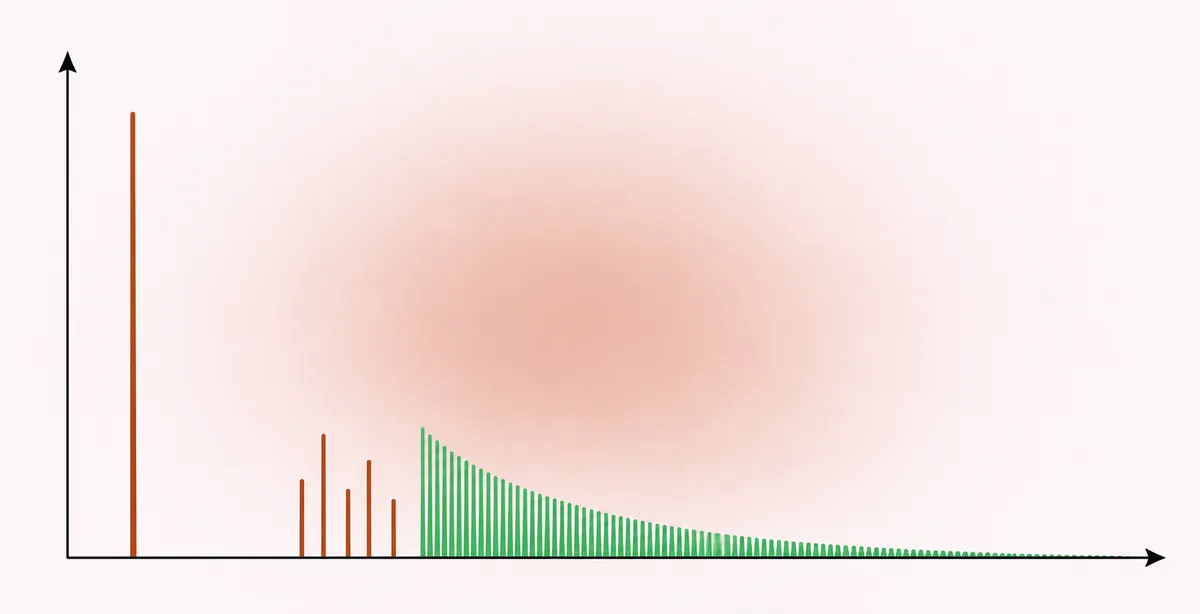
The anatomy of a reverb
Every reverb, whatever its type, can be described with a few parts:
- Pre-delay: the gap between the direct sound and the first reflections. In a real room it reflects how far you are from the walls.
- Early reflections: the first distinct echoes, roughly within the first 50 to 80 ms. They give the brain most of its information about the size and shape of the space.
- Decay or tail: the dense later reverberation. Decay time, often written RT60, is the time it takes for the tail to fall by 60 dB.
- Diffusion and density: how quickly the reflections build into a smooth wash. Low diffusion sounds grainy and echoey; high diffusion sounds smooth.
- Damping: how fast the high frequencies die compared with the lows. Real rooms absorb highs faster, so damping makes a reverb sound natural.
Room
A room reverb simulates a small to medium space: a studio live room, a bedroom, a classroom. Decay is short, usually 0.3 to 1.2 seconds, and early reflections are prominent. Room reverbs are often more about adding a sense of space and liveliness than about an audible tail.
Typical jobs: drums, especially as a short ambience to glue a kit together; acoustic guitar; backing vocals that need to sit behind the lead. A room setting can make a close-miked, dry recording feel as if it was played in a real space.
Plate
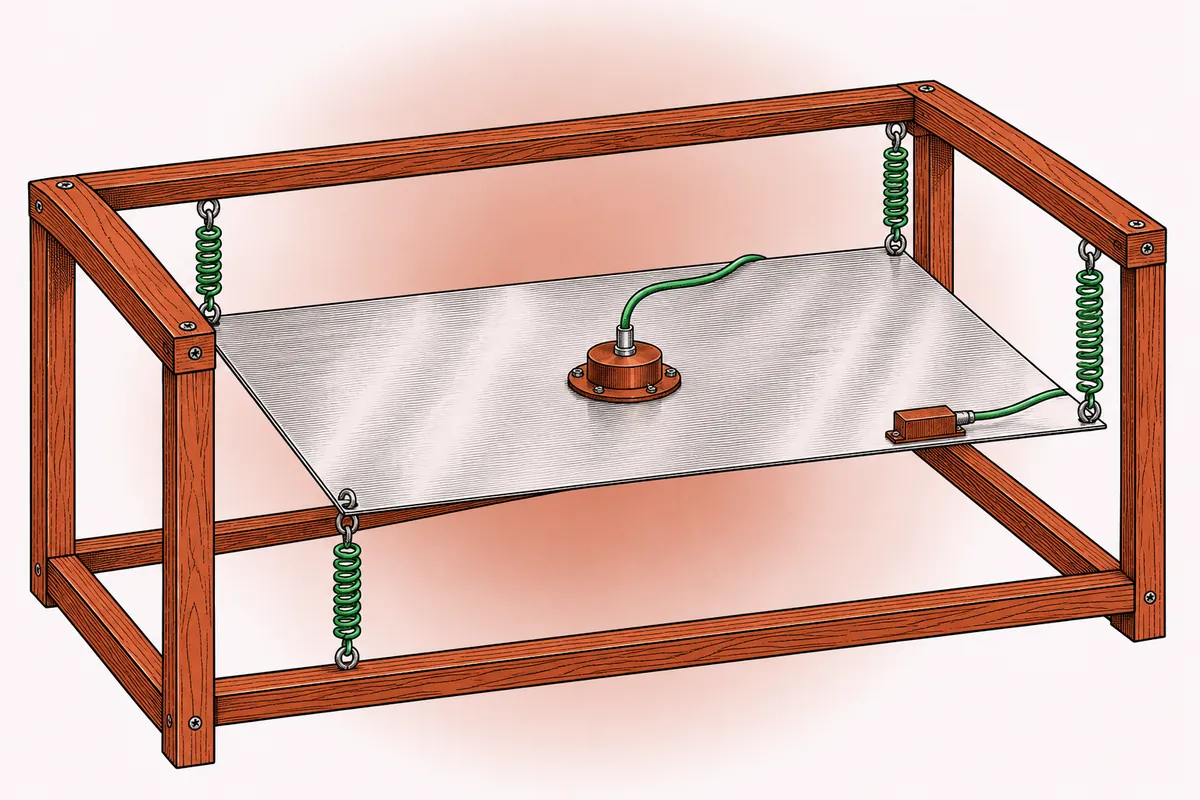
A plate is a large thin sheet of metal, suspended in a frame, driven by a transducer and picked up by a contact microphone. The vibrations spread across the metal and produce a dense, bright, smooth reverb with no clear early reflections. Plates do not sound like any real room, which is part of their appeal: they add shine and sustain without placing the sound in an obvious space.
Typical jobs: lead vocals, snare drum, and anything that needs to sound polished and up front while still having a tail. Decay times between 1 and 2.5 seconds are common starting points. Digital plate algorithms imitate the same character.
Hall
A hall reverb models a concert hall: a large space with a long, smooth decay of 1.8 to 3 seconds or more and a gentle build-up. Halls often have a slightly warmer, darker tail because the large air volume and the surfaces absorb high frequencies.
Typical jobs: orchestral and choral material, ballads, pads, strings, and any sound you want to place far away in a big space. Because the tail is long, halls take up a lot of room in a dense mix. Use them sparingly in busy arrangements or shorten the decay.
Chamber
An echo chamber is a dedicated room, often with hard, angled walls, where a speaker plays the signal and microphones pick up the reverberant result. The sound sits between a room and a hall: denser and more colored than a room, shorter and less diffuse than a hall. Chambers have a lively, slightly hard character that suits many vocal and string sounds in older pop recordings.
Typical jobs: vocals and strings that should sound vintage and natural, guitars, horns. Digital chamber algorithms model this character; decay times around 1 to 2 seconds are typical.
Spring
A spring reverb sends the signal through one or more coiled metal springs. The result is boingy, metallic and splashy, especially on transients. Spring reverbs are a classic part of guitar amplifiers and of dub and surf music.
Typical jobs: electric guitar, organ, creative effects on vocals or drums. A spring rarely sounds realistic, which is precisely why it works as a character effect. Hitting it with a snare or a sharp drum transient gives the familiar crash that dub producers love.
Algorithmic versus convolution
Digital reverbs come in two broad families.
Algorithmic reverbs generate reflections with networks of delays, filters and feedback paths. They are efficient, flexible and easy to modulate. You can change size, decay, diffusion and damping freely, and many algorithms add subtle movement that keeps long tails from sounding static.
Convolution reverbs use an impulse response: a recording of how a real space or device responds to a short sound. The plugin applies that response to your audio, reproducing the real space very closely. Convolution is ideal for realistic rooms, specific halls and classic hardware. It is less flexible: decay and size can be adjusted only within limits, and it usually costs more CPU.
| Family | Strength | Limitation |
|---|---|---|
| Algorithmic | Flexible, light on CPU | Less realistic for specific rooms |
| Convolution | Realistic, exact spaces | Fewer controls, heavier |
Neither is better. Many mixes use a convolution room for natural ambience and an algorithmic plate or hall for the lead vocal.
Key settings
Pre-delay
Pre-delay separates the direct sound from the reverb. A pre-delay of 20 to 40 ms on a vocal keeps the consonants clear and the voice up front while the tail still adds size. Setting it to a musical value, such as a 1/32 or 1/64 note at the song tempo, is a common habit. A short pre-delay (0 to 10 ms) pushes a sound farther back, since the reverb arrives with it.
Decay
Match decay to tempo and density. In a fast, busy track, a tail that rings past the next beat clutters the rhythm. A useful starting point: decay short enough that the tail mostly fades before the next important note or snare hit. Slow ballads can carry far longer tails.
EQ on the return
Reverb tails pile up in the low mids and the very top. Two moves on the reverb return solve most problems:
- A high-pass filter around 200 to 500 Hz keeps the reverb from muddying the low end. Bass and kick usually need little or no reverb in any case.
- A low-pass filter or high shelf cut from about 6 to 10 kHz keeps sibilance and cymbals from splashing.
The reverb then sounds clearer and you can raise it more without the mix feeling washed out.
Sends versus inserts
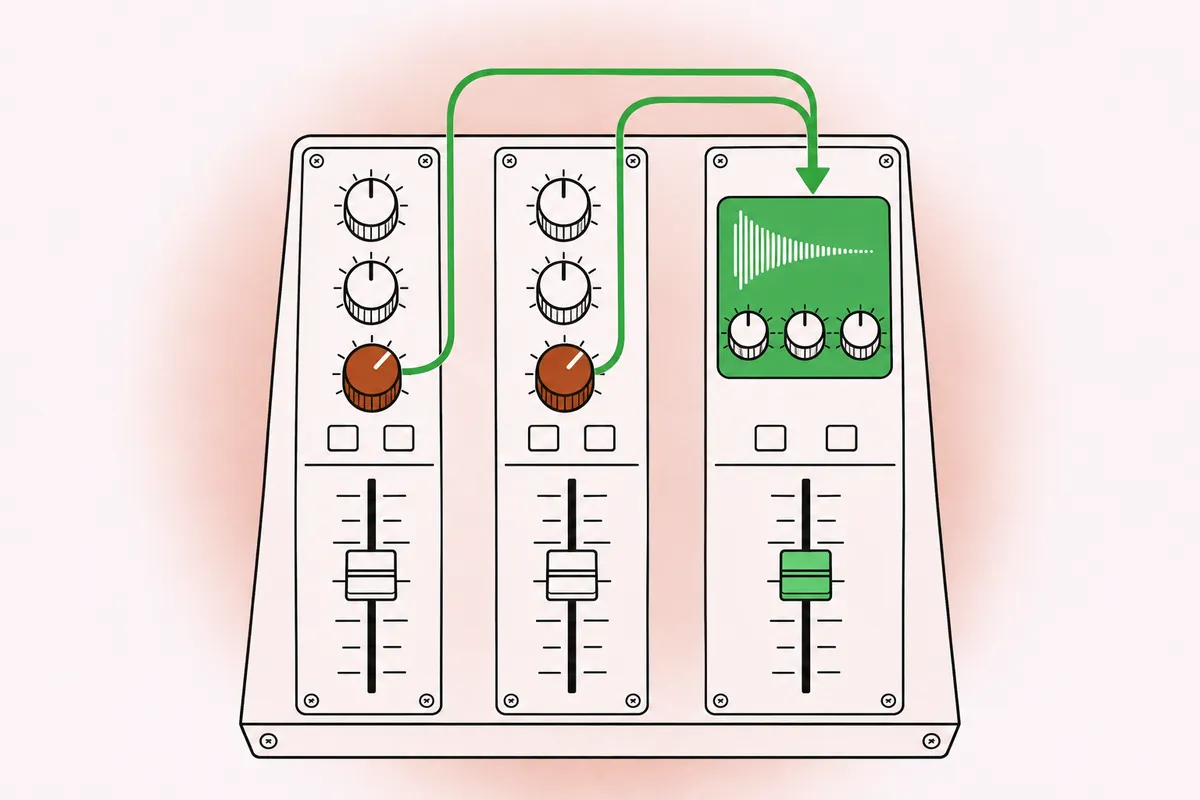
A reverb on an insert processes one track directly, with a wet/dry knob. A reverb on a send sits on its own return channel, set to 100 percent wet, and receives signal from many tracks through send controls. Sends are the standard approach in mixing for several reasons:
- One reverb can serve many tracks, which saves CPU and makes them sound as if they share a space.
- You can EQ, compress or automate the return independently.
- Changing the reverb affects every track that uses it, keeping the mix consistent.
Inserts still make sense for special effects that belong to one sound, such as a spring on a guitar or a gated reverb on a single snare.
Building depth
A practical setup for many mixes uses two or three returns:
- Short room (0.5 to 1 s): a small amount on most instruments, to place them in a common space.
- Plate or chamber (1.2 to 2 s): mainly for vocals and snare.
- Hall or long plate (2 to 3 s): for special moments, pads and big transitions.
Depth comes from combining reverb level, pre-delay and high-frequency content. Sounds closer to the listener are brighter, louder and drier with longer pre-delay. Sounds farther away are darker, quieter and wetter with shorter pre-delay. Pair this with delays for space and movement, which often add size without the clutter of a long tail.
If the reverb tails pump or swell oddly, a compressor on the mix bus might be reacting; the guide to parallel compression and the overview of compressor types help explain the interaction. When everything is in place, check the result with fresh ears using a mix review checklist, and confirm on a different system, since headphones exaggerate reverb.
Quick answers
Which reverb is best for vocals?
Plate and chamber reverbs are the most common choices for lead vocals because they add shine and sustain without placing the voice too far back. A 20 to 40 ms pre-delay keeps the words clear.
What is pre-delay in reverb?
Pre-delay is the gap between the dry sound and the start of the reverb. Longer pre-delay keeps the source up front; shorter pre-delay pushes it back.
Should I put reverb on a send or an insert?
A send is the usual choice: several tracks share one reverb, you can EQ the return, and the mix sounds like one space. Inserts suit effects that belong to a single sound.
Why does my reverb make the mix muddy?
The tail is usually carrying too much low-mid energy. High-pass the reverb return around 200 to 500 Hz and shorten the decay.