Common EQ Mistakes and Why EQ Belongs in Context
Learn to spot the EQ habits that make a mix worse while seeming to improve it, and replace them with a simple routine that judges every move with the whole song playing.
By Delia Marchbanks, in Mixing
Equalization is the tool most home producers reach for first and understand least. It is easy to make a sound brighter, fuller or cleaner on its own. It is much harder to make it fit with twenty other sounds. Most EQ mistakes come from the same root: decisions made without enough context, judged by ears that are fooled by level changes and by the habit of looking at curves instead of listening.
This guide covers the most frequent errors, explains why each one happens, and gives a safer habit to replace it.
Mistake 1: Equalizing in Solo
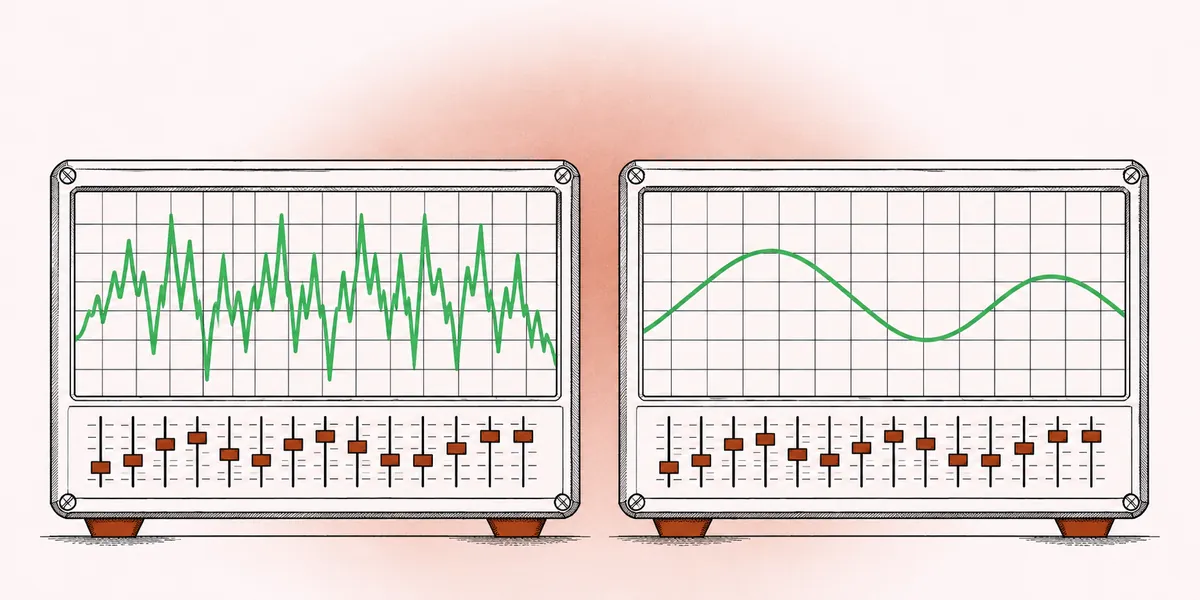
The solo button feels like a microscope. Isolate the snare, and every ring, every boxy note, every bit of hiss becomes obvious. The natural response is to fix all of it. Then the full mix plays again and the snare sounds thin, small and disconnected.
Sounds are heard in combination. Masking means that a loud sound hides quieter sounds near the same frequencies, so many of the flaws you hear in solo are inaudible in the mix. Meanwhile, the qualities that make an element work in context, such as the body of a guitar around 200 Hz or the low mids of a pad, often sound muddy in isolation.
Better habit:
- Make EQ decisions with the full mix playing, or at least with the elements that share the same range.
- Use solo briefly to locate a problem frequency, then un-solo before deciding how much to cut.
- If a sound is too thin in context, it is too thin, regardless of how it sounds alone.
Mistake 2: Boosting Before Cutting
A boost is exciting. Turn up 5 kHz on a vocal and it jumps forward instantly. The problem is that every boost adds level, eats headroom and raises whatever else lives in that range, including noise, sibilance and the parts of the sound you did not want more of.
Often the real issue is that something else is masking the region. If the vocal lacks clarity, the cause can be a buildup around 300 Hz in the vocal itself, or a guitar sitting on top of the vocal's presence range.
Better habit:
- Ask what is hiding the quality you want.
- Cut that first, either on the same track or on the competing one.
- Boost only if the cut alone does not get you there.
Boosting is not wrong. Air shelves, gentle presence lifts and low shelves on thin sources are all legitimate. But try the subtractive route first, and you will usually need less boost.
Mistake 3: Using a Q That Is Too Narrow
Narrow filters look precise, and precision feels professional. A Q of 8 or 10 cuts a sliver of spectrum, which is exactly right for a ringing resonance or a single hum harmonic. It is wrong for shaping tone.
Musical sounds have energy spread across a range. A boxy tom is not boxy at exactly 412 Hz; the quality spans a broad area around it. A very narrow cut there removes little audible boxiness and can leave a hollow, phasey artifact.
| Job | Typical Q | Typical gain |
|---|---|---|
| Tone shaping | 0.5-1.5 | 1-4 dB |
| Clearing a region | 1-2 | 2-5 dB |
| Taming a resonance | 4-10 | 3-10 dB cut |
Keep narrow, deep cuts for real resonances. For everything else, wider and gentler usually sounds more natural.
Mistake 4: Assuming Louder Means Better
The ear is not neutral. When a sound gets louder, it seems fuller and brighter, partly because human hearing sensitivity to low and high frequencies increases with level. Any EQ move that raises overall level, even by 1 dB, tends to win a quick comparison.
That is why a boost so often seems like an improvement, and why switching an EQ on and off without compensating gain is close to useless.
Better habit:
- Use the output gain of the EQ to match levels between processed and bypassed versions.
- Compare by ear over several seconds, not by watching meters alone.
- If the processed version only wins when it is louder, the EQ move was not an improvement.
The same principle applies when comparing your mix to a reference, a point covered in the guide on reviewing your own mix.
Mistake 5: Fixing Arrangement Problems With EQ
Some mixes fight EQ because the conflict is musical, not technical. Two guitars playing the same chord voicing in the same octave, a pad and a piano both filling the midrange with sustained chords, a bass line doubling the kick rhythm with long notes: no amount of carving fully separates parts that occupy the same space at the same time.
Signs that the problem is the arrangement:
- You keep cutting the same range on several tracks and the mix still feels crowded.
- Muting one part makes everything clearer, and you do not miss the muted part.
- Every element sounds fine alone and the chorus still sounds like mush.
Better habit: consider moving a part up or down an octave, simplifying a rhythm, removing a layer in the verse, or giving parts alternating space rather than playing all at once. If you are still producing, these changes are cheaper than any processing.
Mistake 6: Reaching for Linear Phase by Default
Regular EQs (often called minimum phase) shift the timing of frequencies around each band. The shift is small and is part of the sound of every analog equalizer. Linear phase EQs remove that shift, which sounds like a pure upgrade but comes with costs:
- Latency: linear phase modes add delay, sometimes tens of milliseconds, which is a problem while tracking. The guide to buffer size and latency explains how this interacts with your session.
- Pre-ringing: steep linear phase filters can create a faint smear before sharp transients, such as kick drums and snares. It sounds like a soft swish just before the hit.
- CPU: they often use more processing.
Linear phase is useful in specific cases, such as parallel processing of the same signal, multiband splits or mastering low shelves where phase coherence between bands matters. For most mix tasks, a standard EQ sounds natural and avoids pre-ringing.
Mistake 7: Ignoring What the High-Pass Takes Away
High-pass filters on every non-bass track are good practice, but a filter set too high by habit removes the warmth that holds a mix together. Twenty tracks each losing a little body add up to a thin, cold mix.
Set each high-pass with the mix playing. Raise it until the sound starts to change, then lower it a little. For a vocal, that often lands somewhere between 70 and 120 Hz, but it depends on the singer and the song. The guide on low end in a small-room mix explains how filtering interacts with the kick and bass.
Mistake 8: Trusting the Analyzer Over the Ears
Spectrum analyzers are excellent for spotting rumble, checking sub content you cannot hear on small speakers and finding a resonance quickly. They are poor judges of balance. A mix can look smooth on an analyzer and sound wrong, or look lumpy and sound great, because the analyzer cannot weigh musical importance.
Use the display to confirm and locate, not to decide.
A Routine for EQ in Context
- Set a rough balance with faders first. Many perceived EQ problems are level problems.
- Play the full mix or the relevant group.
- Identify one specific problem and say it in words: "the vocal sounds dull," "the guitars mask the snare."
- Find the range responsible with a quick sweep, in solo if needed.
- Return to the full mix, choose cut or boost, set a broad Q and adjust the gain until the problem resolves.
- Match levels and compare with bypass.
- Move on, and revisit after a break.
Applied consistently, this routine prevents most of the mistakes above. For specific cases, see the guide on EQ for electronic music mixing and mastering and the one on mixing the kick drum.
Quick answers
Is it always wrong to EQ in solo?
No. Solo is useful for finding a resonance or a specific problem. Make the final decision about how much to cut or boost with the mix playing.
What Q value should I start with?
For general tone shaping, a Q between 0.7 and 1.5 is a good start. Go narrower only for resonances or hum.
Why does every EQ boost sound better at first?
Boosts usually raise overall level, and louder sounds seem fuller and brighter. Matching output level before comparing removes that bias.
When is linear phase EQ worth it?
It helps in mastering, multiband processing and parallel chains where phase coherence matters. For most individual tracks, a standard EQ is enough and avoids pre-ringing and latency.