Compressor Types Explained: VCA, FET, Optical, Vari-Mu and Digital
This guide explains the main compressor designs, why each one reacts the way it does, and how to pick the right type for drums, vocals, bass and the mix bus.
By Delia Marchbanks, in Compression & Dynamics
Every compressor does the same basic job: when the signal rises above a threshold, it turns the level down by an amount set by the ratio. What differs from one design to the next is how the circuit senses the level and what physically turns it down. Those two choices shape how fast the unit reacts, how it lets go, and what it adds to the tone. Understanding the different compression types helps you reach for the right one first, instead of fighting a design that was never meant for the job.
This guide walks through the five families you will meet on hardware and in plugin form: VCA, FET, optical, variable-mu and digital. Brand names appear only where a circuit has become the reference for its family.
Two parts of every compressor
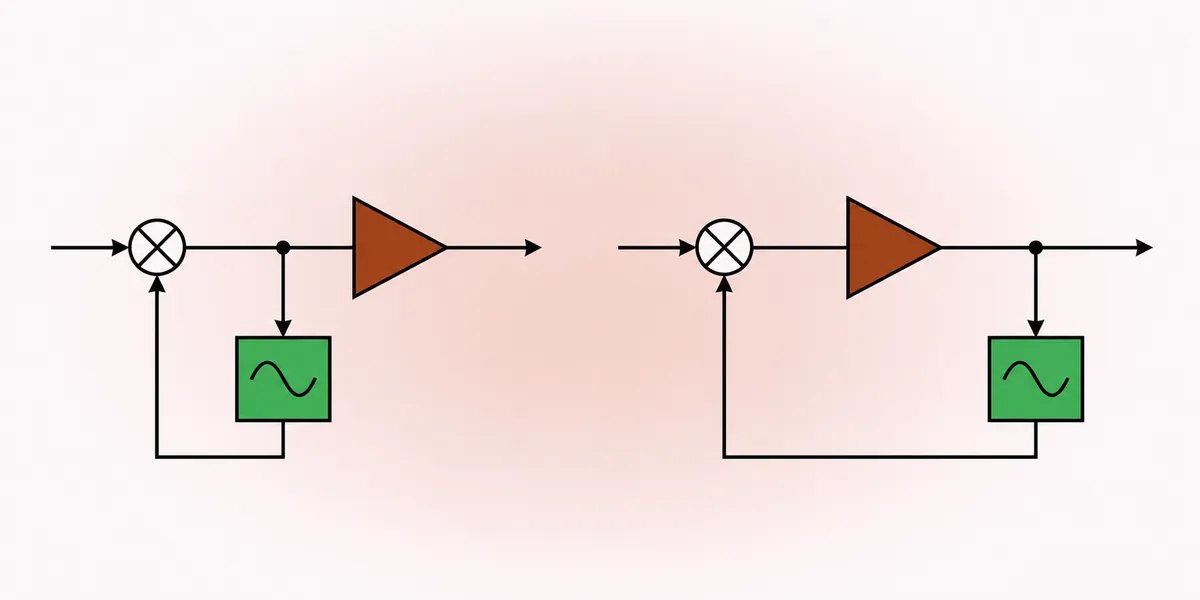
A compressor has a detector and a gain element. The detector, also called the sidechain, reads the incoming level and decides how much reduction is needed. The gain element is the part that actually lowers the volume.
The detector can read the signal before the gain element (feedforward) or after it (feedback). Feedforward designs react to the raw input and can hold an exact ratio, which makes them precise and capable of hard limiting. Feedback designs listen to their own output and correct themselves, which tends to produce a softer, more forgiving response. Many classic tube and optical units are feedback designs; many modern VCA units are feedforward.
The detector also chooses between reading peaks or an average level close to RMS. Peak sensing grabs transients quickly. Averaging responds more like the ear does to loudness, so it reacts less to sharp hits and more to sustained level.
VCA compressors: precise and fast
A voltage controlled amplifier is a small circuit whose gain follows a control voltage. Feed it the detector output and you have a compressor that can do almost anything: very fast or slow attack, any ratio, hard or soft knee, clean behavior at heavy reduction.
Character. VCA designs are usually the most neutral of the analog types. They add little color at moderate settings, though some classic units impart a firm, slightly forward punch. Because the control path is exact, they can clamp down on transients and then release cleanly.
Typical controls. Threshold, ratio, attack, release, makeup gain, often a knee control and a sidechain high-pass filter.
Where they shine:
- Drum bus and individual drums, where you want to shape the attack of each hit.
- Bass guitar, for steady level control without obvious tone change.
- The mix bus, where the console bus compressor of the large-format desk era is the best-known example. The guide on the SSL-style bus compressor covers that circuit in detail.
If you are unsure what a track needs, a VCA compressor is a safe first reach because it does what the knobs say.
FET compressors: aggressive and colorful
A field effect transistor can act as a variable resistor, which makes it a very fast gain element. The famous example is the 1176 family, whose attack can be set somewhere around 20 to 800 microseconds and whose release runs from about 50 ms to over a second. Those attack times are fast enough to catch nearly any transient.
Character. FET units add harmonic distortion that grows with gain reduction and with drive into the input. The result is a sound often described as bright, energetic and forward. Pushed hard, they become obvious on purpose.
Controls. Many FET designs have no threshold. Instead, an input knob drives the signal harder into a fixed threshold, and an output knob sets the level afterward. Ratios are usually stepped, for example 4, 8, 12 and 20 to 1. On the 1176 style, pressing all ratio buttons at once gives a heavily distorted, pumping effect used on room microphones and drums.
Where they shine:
- Lead vocals in rock and pop, to bring a voice forward and hold it there.
- Room microphones and drum overheads, for crushed, exciting ambience.
- Electric bass and guitars that need bite.
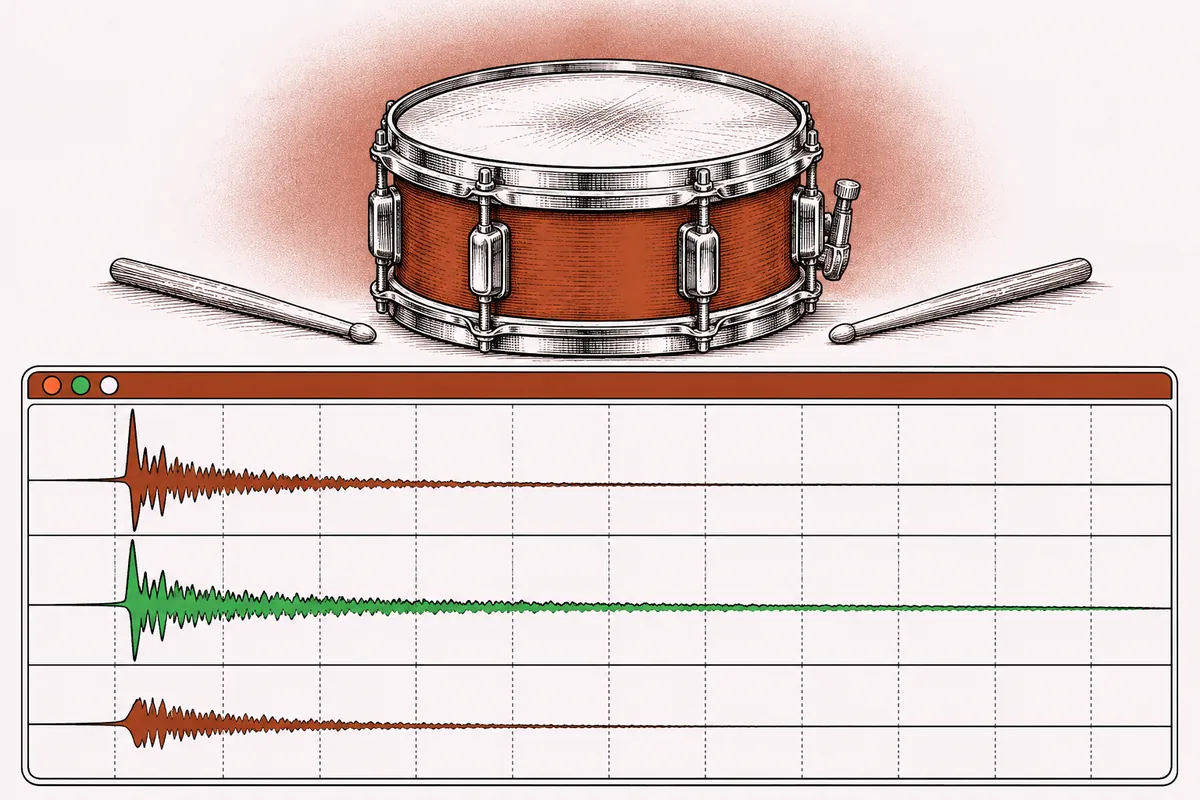
Fast attack on a FET can dull a drum by shaving off its front edge. If the snare loses its crack, slow the attack so the first few milliseconds pass untouched.
Optical compressors: smooth and musical
An optical compressor uses a light source and a light-dependent resistor. The detector drives the light; the brighter it glows, the more the resistor lowers the signal. The reference here is the LA-2A, which uses an electroluminescent panel inside its T4 cell.
Character. The light cell cannot react instantly, so attack is moderate, often around 10 ms. Release is the interesting part: the cell recovers in two stages, a quick first portion of perhaps 40 to 80 ms, followed by a much slower tail that can take one to several seconds, depending on how long and how hard it was compressed. This program-dependent release follows the music naturally. Optical units rarely sound grabby.
Controls. Often just two knobs: peak reduction (how much compression) and gain (output). Some have a switch between compress and limit. The simplicity is the point.
Where they shine:
- Vocals, especially for steady leveling across a long phrase.
- Bass guitar, to even out notes without killing the attack.
- Acoustic instruments and pads where you want control you do not hear.
Optical compressors pair well with a faster unit placed before them. A FET catching peaks first, followed by an optical unit doing the slow leveling, is a classic vocal chain because each stage only does a little.
Variable-mu compressors: gentle glue
In a variable-mu design, the gain element is a vacuum tube whose amplification factor (mu) changes with the control voltage. The more level the detector sees, the lower the gain. The reference designs are the Fairchild 660 and 670 and later tube mastering units.
Character. The ratio is not fixed. It starts low and rises as the signal gets louder, which produces a very soft knee. Small amounts of reduction sound almost invisible, while the tubes add mild even harmonics and a sense of density. Attack and release are usually moderate to slow, often selected with a stepped time constant switch.
Where they shine:
- The mix bus and mastering at home, at 1 to 3 dB of gain reduction, for cohesion.
- Stereo groups like backing vocals or strings.
- Any source where you want warmth and gentle control rather than precision.
Variable-mu units cannot react to quick transients the way a FET or VCA can. That is a feature on a full mix: the punch of the drums passes through while the overall level sits more evenly.
Digital and lookahead compressors
Software compressors can emulate any analog type, but purely digital designs also do things analog circuits cannot.
Lookahead. A plugin can delay the audio by a few milliseconds while the detector reads ahead. The compressor then knows a peak is coming before it arrives, allowing true zero-attack limiting without overshoot. The cost is latency, which the DAW compensates during mixing but which can affect live monitoring. The guide on buffer size and latency explains why heavy lookahead plugins are best bypassed while tracking.
Transparency. A clean digital compressor can apply heavy gain reduction with no added harmonics at all, useful for dialogue, classical recordings and mastering where color is unwanted.
Multiband and dynamic EQ. Splitting the signal into frequency bands lets you compress only the low end or only the sibilance. This is how most modern de-essing is done.
Extras. Mix knobs for built-in parallel compression, external sidechain inputs, and detailed metering. The parallel compression guide explains why the mix knob is so useful.
Diode bridge and other variants
A few designs do not fit the five families neatly. Diode bridge compressors, found in some classic console channel modules, use a network of diodes as the gain element. They sit somewhere between VCA and variable-mu in character: fairly fast, with noticeable harmonic color. Pulse width modulation designs switch the signal on and off at a very high rate to control gain, giving a clean and fast response. You will mostly meet these as plugin emulations and can treat them by ear.
Matching the type to the job
| Job | First choice | Why |
|---|---|---|
| Snare or kick shaping | VCA or FET | Fast, precise attack control |
| Lead vocal leveling | Optical, then FET | Smooth riding plus peak control |
| Bass guitar | Optical or VCA | Even notes, attack preserved |
| Drum room crush | FET | Color and aggressive pumping |
| Mix bus glue | VCA or vari-mu | Gentle, cohesive reduction |
| Mastering | Vari-mu or clean digital | Transparency or warmth |
| De-essing | Digital split-band | Frequency-specific control |
These are starting points, not laws. A FET on a mix bus can sound exciting on a rock track, and an optical unit on a snare can give a pleasingly lazy response. The table is a way to make the first choice quickly.
Setting any compressor by ear
Whatever the type, the same method works:
- Set the ratio around 3 or 4 to 1 and push the threshold low enough to hear obvious compression, perhaps 10 dB of reduction.
- Adjust attack while listening to the front of each note. Slower attack lets the transient through; faster attack tames it.
- Adjust release so the gain recovers in time with the music. Too fast sounds grainy on low notes; too slow means the compressor never lets go.
- Back the threshold off until reduction is where the track needs it, often 2 to 6 dB on individual sources.
- Match the output level to the bypassed sound before deciding whether the compression helps. Louder always seems better, so compare at equal loudness, the same trap that drives the race for louder mixes.
The attack and release guide goes further into timing, and the compression hub collects every guide on dynamics.
Quick answers
Which compressor type is best for vocals?
Optical units are a common first choice for smooth leveling, often with a FET before them to catch peaks. A clean VCA also works well when you want precise control without color.
Is a FET compressor too aggressive for the mix bus?
Usually it is more color than most mixes want at that stage, but light settings can suit energetic rock. VCA and variable-mu designs are the more common mix bus picks.
Why does my optical compressor feel slow?
The light cell has a fixed reaction time of several milliseconds, and its release has a long tail. That slowness is the character of the design, so use a faster type when you need to catch sharp transients.
Do plugin emulations behave like the hardware?
Good emulations model the detector timing and the harmonic color closely, so the same settings advice applies. Treat them by the same rules and judge the result at matched levels.