De-Essing Vocals: Taming Sibilance Without Dulling the Voice
This guide helps you find the sibilant frequency of a voice, choose between a split-band, wideband or dynamic EQ de-esser, fix stubborn esses by hand, and place the de-esser at the right point in the chain.
By Delia Marchbanks, in Compression & Dynamics
Sibilance is the hissing energy of consonants like s, sh, z, ch and soft t sounds. Every voice has it, and a recording needs some of it to stay intelligible. The trouble starts when those consonants jump out far louder than the vowels around them, sounding harsh on speakers and painful on earbuds. Equalization alone cannot fix this, because cutting the sibilant frequencies all the time also dulls every vowel. A de-esser is a compressor that only reacts to those consonants, and only for the few milliseconds they last.
This guide covers where sibilance lives, the main types of de-esser, a manual method for the toughest cases, and where de-essing fits in a vocal chain.
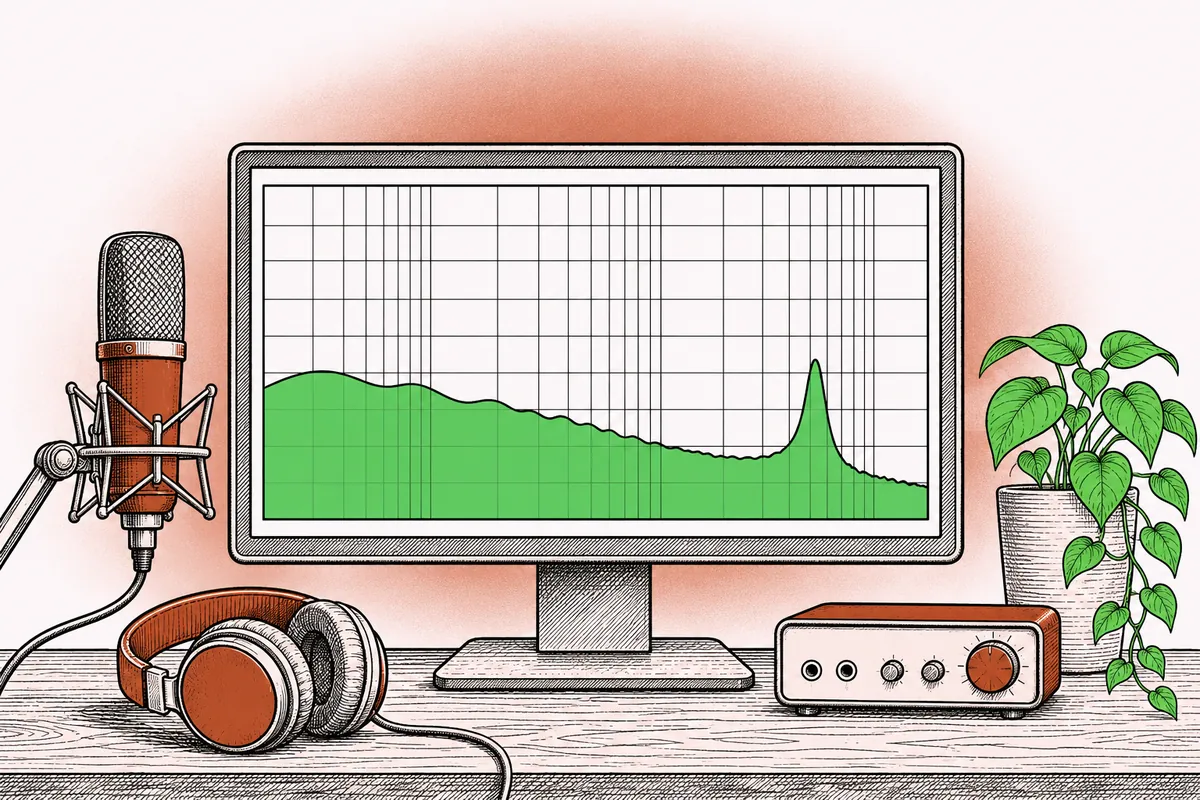
Where sibilance sits
Sibilant energy usually falls between about 4 and 10 kHz. The exact center varies a lot with the singer, the microphone and the distance.
- Lower, darker voices often show sibilance around 4 to 7 kHz.
- Higher, brighter voices often peak around 6 to 10 kHz.
- Sh and ch sounds tend to sit lower than s sounds on the same voice.
- Bright condenser microphones and close placement exaggerate the problem.
To find the frequency on a given track:
- Insert an EQ with a narrow boost of 8 to 10 dB.
- Sweep slowly through 3 to 12 kHz while the vocal plays.
- The point where the esses become painfully loud is your target. Remove the boost afterward.
An analyzer helps too. Watch for a narrow peak that appears only on consonants. Many de-essers have a listen or monitor button that lets you hear only what the detector picks up, which makes the search faster.
Much of the problem can be reduced at the source. Angling the microphone slightly off the mouth, adding a few inches of distance, or placing the pop filter a little farther out often softens sibilance before any processing. The guide on recording vocals at home covers placement in more detail.
Split-band de-essers
A split-band de-esser divides the signal into two parts with a filter. When the high band crosses the threshold, only that band is turned down. The low and mid range of the voice passes unchanged.
Strengths. Precise and usually transparent at moderate settings. The body of the voice keeps its level even during an s.
Watch out for. If the band is set too wide, or the reduction too deep, the de-esser starts removing air and brightness on every syllable, not only the consonants. The voice can also sound lispy when esses lose their edge entirely.
Typical starting points: frequency at the sibilant peak, a high-shelf or band shape covering roughly one octave around it, 3 to 6 dB of reduction on the worst consonants.
Wideband de-essers
A wideband de-esser uses the same filtered detector, but when it triggers, it turns down the whole signal for the duration of the consonant. The detector only listens to the sibilant band; the gain reduction affects everything.
Strengths. Very natural sound, since the tone of the consonant does not change, only its level. It suits voices where the s is too loud overall rather than too bright.
Watch out for. Heavy settings create audible dips in the vowel that follows. Keep reduction moderate, often 2 to 5 dB, and use fast attack with a release around 20 to 60 ms so the gain recovers before the next vowel.
Many plugins offer both modes behind a switch. Try both on a given voice, compare at matched loudness, and keep whichever sounds less processed.
Dynamic EQ as a de-esser
A dynamic EQ band behaves like an EQ that only engages when its band exceeds a threshold. Set a bell or shelf at the sibilant frequency, give it a threshold that only the loudest esses reach, and choose a reduction range of a few decibels.
The advantages are flexibility and precision: you can pick the shape (narrow bell, broad bell, shelf), set different bands for s and sh, and see exactly how far each band moves. Some dynamic EQs also accept an external key, which is the same principle described in the guide on sidechain compression.
Dynamic EQ is a strong default for most modern vocal work. A multiband compressor can do the same job, though it is usually less precise in shape.
Manual de-essing with clip gain
Some voices have a handful of extreme consonants that no automatic setting catches without damaging the rest. In that case, fix them by hand.
- Zoom into the waveform. Sibilant bursts look dense and noisy compared with the rounder shape of vowels.
- Select each loud consonant and lower its clip gain, usually by 3 to 8 dB.
- Use short fades at the edges of each region so the change is not audible.
- Play back in context, not soloed.
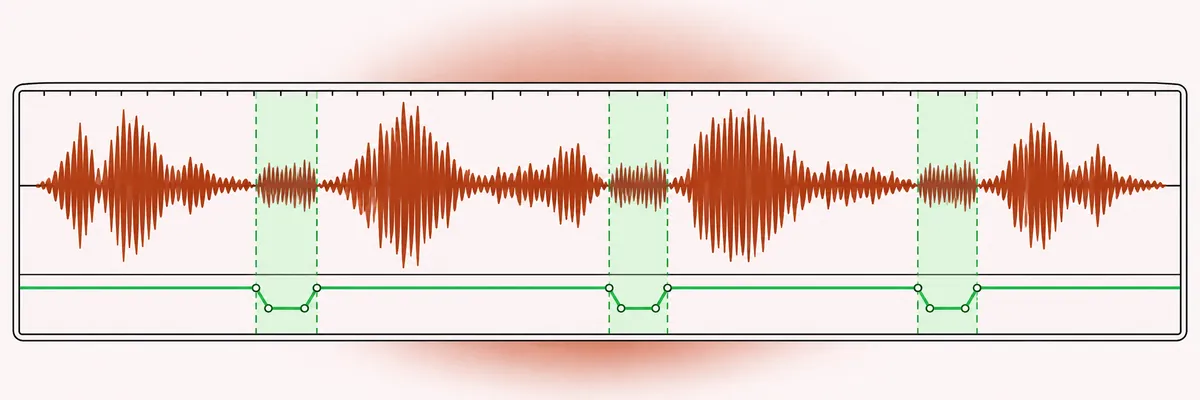
This is slower, but it is the most transparent method because nothing else is touched. It also helps any compressor that follows, because it removes peaks that would otherwise trigger gain reduction on a consonant rather than a phrase. Some editors use automatic de-essing for the general reduction and manual edits for the few remaining problems.
Where the de-esser goes in the chain
There is no single correct order, but the reasons behind each position help you decide.
| Position | Why |
|---|---|
| Before compression | Stops esses from triggering the compressor |
| After compression | Catches sibilance the compressor brought up |
| After bright EQ or saturation | Controls the extra top end those stages add |
| Before reverb and delay sends | Keeps esses from splashing into the effects |
Compression often makes sibilance worse. A fast compressor turns the vowels down, while short consonants slip through and end up relatively louder. That is why many vocal chains place a light de-esser before the compressor and a second one later, after a high-frequency boost or saturation. Two gentle stages of 2 to 3 dB usually sound more natural than one heavy stage.
Sibilance in reverb and delay is especially noticeable, because the effect repeats or smears each s. A de-esser on the send, or before the send point, keeps the effect returns smooth. If you use parallel compression on vocals, place the de-esser before the parallel split so the crushed copy does not exaggerate every consonant.
For the compressors that sit around the de-esser, the guide to compressor types explains what each design does to the top end of a voice.
Beyond the lead vocal
The same tools help elsewhere in a mix.
- Stacked backing vocals. When several takes sing the same words, their esses rarely line up exactly, and the result sounds like a spray of hiss. De-ess the backing vocal bus, and consider trimming the sibilants on all but one take so only a single s is heard.
- Cymbals and hi-hats. A split-band de-esser set around 6 to 9 kHz can tame a harsh ride or a piercing hat on an overhead pair without darkening the whole kit.
- Spoken word. Dialogue usually needs gentler settings than singing, since listeners notice lisping on speech very quickly.
Sibilance is easy to misjudge on bright headphones or tired ears. Check the vocal at a moderate level, again on small speakers or earbuds, and after a break. The guide on mixing on headphones explains why the top end reads differently there.
Signs of over de-essing
- The voice sounds lispy, as if the singer has trouble pronouncing s.
- Words become harder to understand at low playback levels.
- The overall vocal sounds dull compared with the rest of the mix.
- The gain reduction meter moves on nearly every syllable, not just consonants.
If you notice any of these, raise the threshold or reduce the range until the meter only moves on the obvious offenders. A good check is to bypass the de-esser at matched level: the processed version should sound smoother, not darker.
Quick answers
What frequency should I de-ess at?
Find it by sweeping a narrow EQ boost between 3 and 12 kHz. Most voices land somewhere between 4 and 10 kHz, lower for darker voices and higher for brighter ones.
How much reduction does a de-esser need?
Often 3 to 6 dB on the worst consonants is enough. If the meter moves on every syllable, the threshold is too low.
Should the de-esser go before or after the compressor?
Both positions work. A light stage before compression keeps esses from triggering it, and a second light stage after bright EQ catches what the chain added.
Can I de-ess without a plugin?
Yes. Lowering the clip gain of each loud consonant by hand, with short fades, is the most transparent method, though it takes longer.