Practical Acoustics for a Home Studio: Modes, Reflections and Traps
This guide shows how a small room colors what you hear, where absorbers and bass traps belong, how thick they need to be, and in which order to spend effort on treatment.
By Delia Marchbanks, in Room & Monitoring
Every room adds its own sound to what comes out of the speakers. In a small, square-ish bedroom with hard walls, that added sound can be louder than the differences you are trying to judge in a mix. Acoustic treatment does not make a room sound "good" in a general sense; it makes the sound at your listening position closer to what the speakers actually produce, so decisions translate to other rooms.
The order matters. Place the speakers and the chair well first, as described in the guide on monitor placement in a home room, then treat what placement could not fix.
Treatment is not soundproofing
These two words are often mixed up, and the confusion wastes effort. Soundproofing (isolation) stops sound from passing through walls, floors and doors. It relies on mass, airtight seals and decoupled structures: double drywall, resilient channels, solid doors with seals, room-within-a-room construction. Foam and fabric panels contribute almost nothing to isolation.
Treatment controls how sound behaves inside the room: how long it rings, which reflections reach your ears, how uneven the bass is. Absorbers, bass traps and diffusers are treatment tools.
If neighbors complain or a car horn shows up on your vocal take, the answer is isolation, or recording at quieter hours. If your mixes have unpredictable bass and the stereo image feels smeared, the answer is treatment. Many home studios need only the second.
Room modes: why the bass is uneven
Between two parallel walls, sound at certain frequencies forms standing waves. At these frequencies, called room modes, the pressure is very high in some places and very low in others. The first axial mode between two walls is the speed of sound (about 343 m/s) divided by twice the distance:
| Room dimension | First axial mode | Second |
|---|---|---|
| 2.5 m | 69 Hz | 137 Hz |
| 3.5 m | 49 Hz | 98 Hz |
| 4.5 m | 38 Hz | 76 Hz |
Each dimension (length, width, height) has its own series of modes, and there are tangential and oblique modes involving more surfaces. In a small room, these modes are spread far apart in the low end, so instead of a smooth response you get distinct peaks and dips that can reach 10 to 20 dB in the 30 to 200 Hz range. Move the chair 30 cm and a bass note that boomed can almost vanish.
Rooms where two or three dimensions are equal or simple multiples of each other (a 3 m by 3 m room with a 3 m ceiling is the extreme case) stack modes on the same frequencies and sound the worst. Nothing short of moving walls fixes the proportions, but knowing them tells you which frequencies to watch.
Two things help with modes: careful choice of listening position (away from the middle of the room and away from walls) and bass trapping. Equalization on the monitor feed can reduce peaks a little but cannot fill deep nulls, because those are cancellations; adding energy just adds more to cancel.
First reflections and the mirror trick
The second big problem is early reflections. Sound from each speaker reaches your ears directly, then a few milliseconds later from the side walls, the ceiling, the desk and the floor. These reflections arrive close enough in time to blend with the direct sound and produce comb filtering, a pattern of narrow peaks and dips across the midrange and highs. The stereo image loses focus and the tone changes as you move your head.
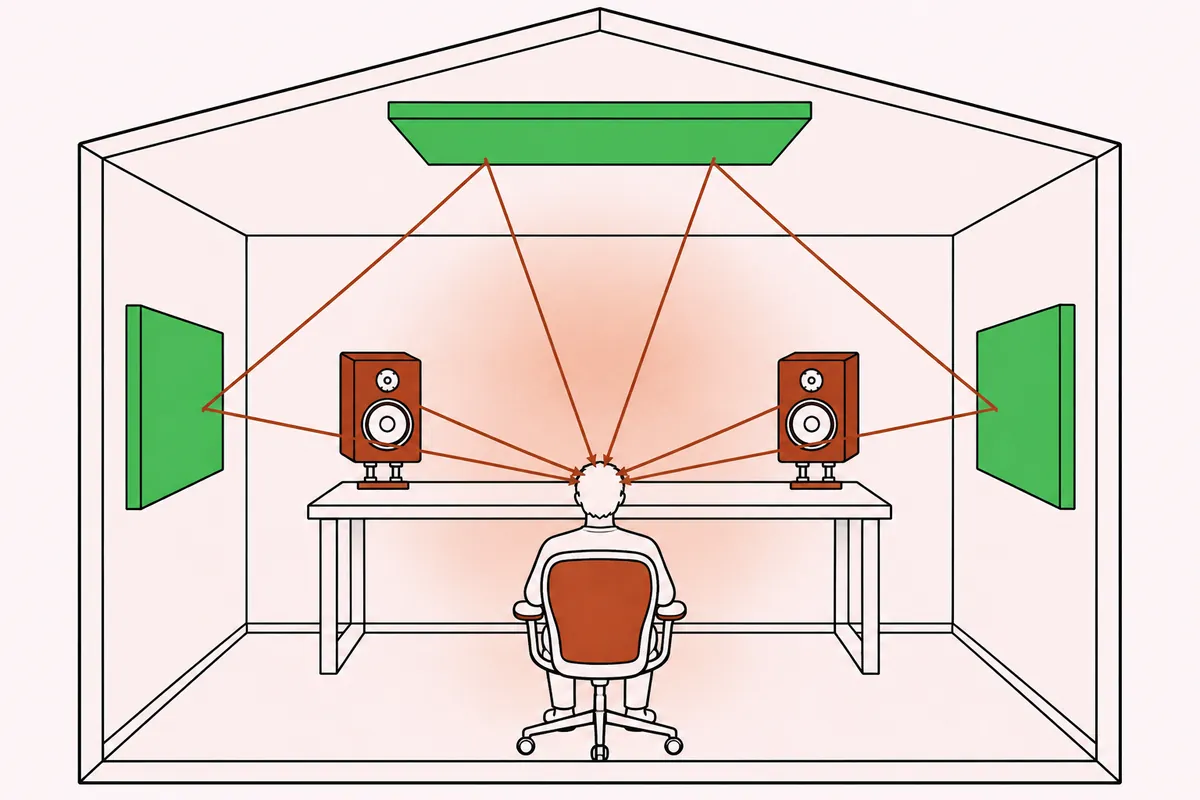
Finding the reflection points takes two people and a mirror:
- Sit in the mixing position.
- Have someone slide a small mirror flat against the side wall, starting near the speaker and moving toward you.
- When you can see the tweeter of the nearer speaker in the mirror, mark that spot. That is a first reflection point.
- Continue to find where the far speaker appears in the same wall's mirror, if it is not too far back.
- Repeat on the other wall and on the ceiling (use a mirror on a stick, or a laser line from the tweeter).
Panels at those points, roughly 60 by 120 cm, centered on the mark, remove most of the side wall reflection. The ceiling cloud above the area between the speakers and your head handles the ceiling bounce. The floor reflection is usually reduced with a thick rug.
How thick an absorber needs to be
Porous absorbers (mineral wool, fiberglass, open-cell foam) work by slowing air particles moving through the material. They are most effective where particle velocity is highest, which is about a quarter wavelength away from a hard wall. For low frequencies the wavelengths are long, so the absorber needs depth, or an air gap behind it.
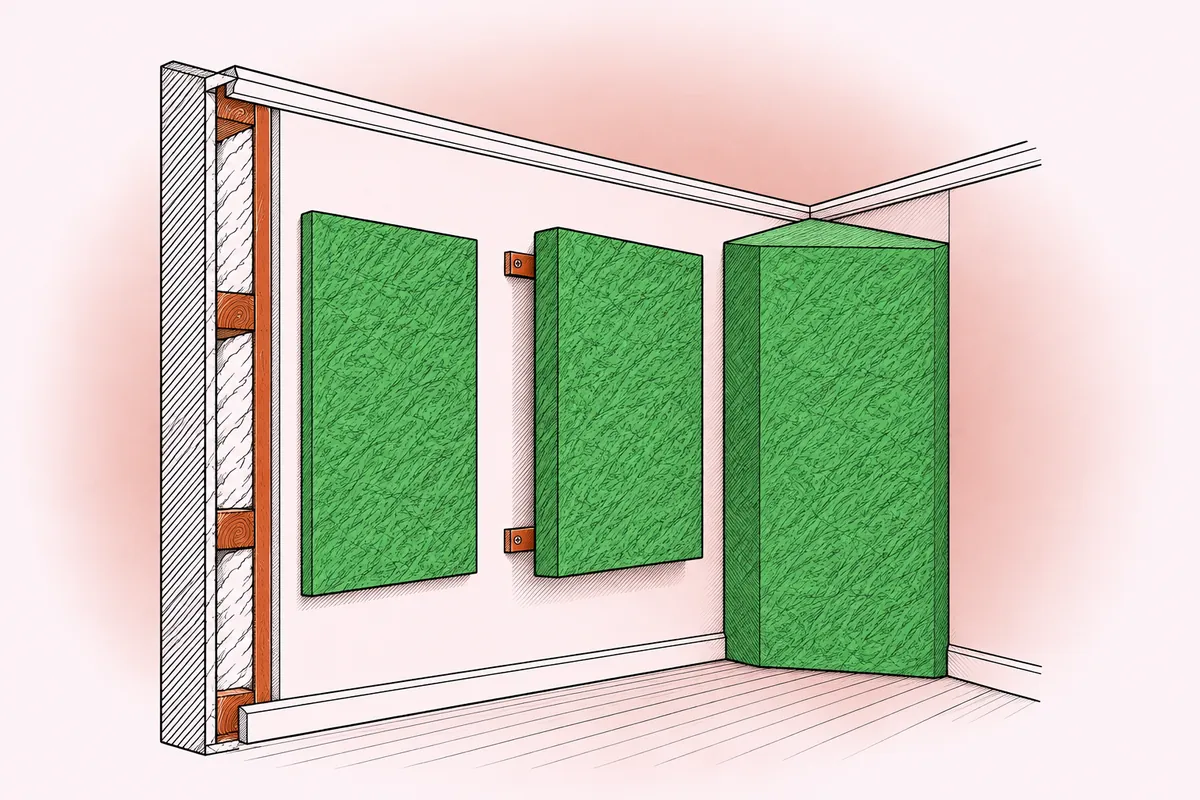
Rough guidance for fibrous panels of typical density:
- 2.5 cm (1 inch) foam or panel: absorbs mostly above about 1 kHz. Useful for flutter echo, but it makes a room dull without touching the bass. Covering walls with thin foam is the most common home studio mistake.
- 5 cm (2 inch) panel: effective down to about 500 Hz, reasonable for reflection points.
- 10 cm (4 inch) panel: effective down to around 250 Hz, and lower with an air gap behind it.
- 10 cm panel spaced 10 cm from the wall: reaches into the 125 to 200 Hz range, often the best value for first reflection panels.
- Corner traps 15 to 30 cm deep or more: needed for real effect below 100 Hz.
Density matters too. Very dense boards reflect more of the high frequencies off their surface; very light material lets the bass pass through. Medium-density mineral wool or fiberglass board, wrapped in a breathable fabric, is the usual choice. Covering a panel in plastic or a non-porous cloth reflects the highs and removes much of its benefit.
Wrap or enclose fibrous material so fibers do not shed into the room, and keep it away from bare skin and lungs while building.
Bass traps in the corners
Room modes all have high pressure at the walls, and the corners, where three surfaces meet, are where pressure peaks for nearly every mode at once. That makes corners the most efficient place for bass absorption.
Practical bass trapping in a home room usually means:
- Floor-to-ceiling traps in the two front corners behind the speakers, then the two rear corners.
- Triangular "superchunk" stacks of mineral wool cut into triangles, or deep panels straddled across the corner with an air space behind them.
- Wall-ceiling corners (soffits) as a second option when vertical corners are blocked by doors or furniture.
More is better with bass trapping, within reason. A few thin corner pieces of foam labeled as bass traps will not change much below 150 Hz. Thick, fibrous traps covering as much corner surface as you can manage are what reduce peaks and shorten the ringing of low notes.
The effect shows up in two ways: peaks drop a little, and decay times shorten. A low note that hung in the room after the bass player stopped now stops closer to when the recording stops, which makes kick and bass relationships far easier to judge. If you can read a waterfall graph from a room analysis program, look at the decay below 200 Hz before and after.
Diffusion in small rooms
Diffusers scatter sound in many directions instead of absorbing it. In large control rooms they keep the space lively at the back without strong echoes. In a small home room, the listening position is usually too close to the walls for a diffuser to work as intended. Most diffusers need a distance of a couple of meters or more between the diffuser and your ears for the scattered reflections to merge into a smooth field.
As a rule for rooms under about 15 square meters, prioritize absorption at reflection points and bass trapping in corners. If the room starts sounding too dead after that, a bookcase with books of varied depth on the back wall offers some scattering and keeps a bit of life. A dedicated diffuser is a late addition, not a starting point.
The flutter echo check
Clap your hands sharply in the middle of the room. A metallic, zippy ring after the clap is flutter echo, caused by sound bouncing between two parallel hard surfaces. It is easy to fix with a couple of thin or medium panels on one of the two surfaces, offset from each other on opposite walls. It is also a quick listening check after treatment: the clap should die away cleanly without a buzz.
Order of effort on a small budget
Treatment can be done in stages. A sensible sequence for most bedrooms and spare rooms:
- Placement. Speakers along the long wall axis, symmetry, listening position near 38 percent of the length, correct front wall distance. Free and often the biggest single change.
- Front corner bass traps. The two corners behind the speakers, as thick and as tall as possible.
- First reflection panels on the side walls, 10 cm thick with an air gap if room allows.
- Ceiling cloud above the area between speakers and listener.
- Rear corner bass traps and a thick panel on the back wall if the room is short.
- A rug on hard floors between the desk and the speakers.
- Room correction software or the speakers' built-in controls to tidy remaining peaks after the physical work, never as a replacement for it.
After each stage, play familiar reference tracks at your usual level and note what changed. Going step by step stops you from over-treating, which is easy with thin foam everywhere.
Living with what is left
Even a well-treated small room keeps some low-end irregularity. That is normal. Cross-check the bass on headphones, as covered in the guide on mixing on headphones, and on a small speaker or a car system. When you plan a microphone recording in the same room, the reflection panels pay off twice; the guide on recording vocals at home explains how to use them around the mic. And if you are still choosing speakers, keep the room size in mind; the piece on choosing studio monitors for a small room explains why a bigger woofer is not always the better choice. Terms like RT60, axial mode and comb filtering are defined in the music production glossary.
Quick answers
Does acoustic foam soundproof a room?
No. Foam absorbs some reflections inside the room but blocks very little sound going through walls. Soundproofing needs mass, airtight seals and decoupled construction.
Where should I put my first acoustic panels?
At the first reflection points on the side walls, found with the mirror trick, then above you on the ceiling. Thick bass traps in the front corners are the other early priority.
How thick should bass traps be?
Aim for at least 15 cm of fibrous material in a corner, and more where possible. Thin foam corner pieces have little effect below about 150 Hz.
Do I need diffusers in a small home studio?
Rarely at the start. Small rooms put you too close to the walls for diffusers to work well, so absorption and bass trapping come first. A full bookcase on the back wall is a reasonable compromise.